Education Is Moving Beyond the Traditional Classroom
Education is entering a period of significant change. Technology is no longer simply an additional tool used inside classrooms. Artificial intelligence, experiential learning, interdisciplinary education and digital collaboration are changing how knowledge is delivered and how students participate in the learning process.
The growing influence of artificial intelligence is particularly significant. AI can help personalize educational experiences, provide immediate learning support and help educators understand individual learning needs. At the same time, education leaders are increasingly recognizing that technology alone cannot define the future of learning.
The real opportunity lies in combining technology with creativity, research, critical thinking and human guidance.
This is where STEAM education is becoming increasingly important.
STEAM brings science, technology, engineering, arts and mathematics together to encourage students to approach problems from multiple perspectives. Instead of separating subjects into isolated areas, the model encourages learners to understand how different disciplines can work together to solve real world challenges.
AI Is Changing What Personalized Learning Can Mean
One of the most important developments in modern education is the movement toward more personalized learning.
Traditional classroom environments often require teachers to work with students who have different abilities, interests and learning speeds. Artificial intelligence can support educators by analyzing learning patterns and helping identify areas where students may require additional guidance.
AI powered educational platforms can recommend learning materials, provide interactive assistance and support continuous assessment. These capabilities can allow students to receive more relevant learning experiences while giving educators additional information to support their teaching.
EliteX recently examined this broader transformation in its feature on how EdTech leaders are driving AI in education, highlighting the growing role of personalized learning, intelligent tutoring, accessibility and responsible AI adoption.
However, the future of education cannot be reduced to automation.
The most valuable educational environments will likely be those where technology strengthens the relationship between learners and educators rather than replacing it.
Why STEAM Matters in an AI Driven World
As AI handles an increasing number of repetitive and information based tasks, uniquely human abilities become even more valuable.
Creativity, curiosity, communication, collaboration, problem solving and the ability to approach unfamiliar situations are becoming essential capabilities for learners preparing for a rapidly changing world.
STEAM education provides a framework for developing many of these abilities.
A student working on an engineering problem may need scientific knowledge, mathematical reasoning, technological skills and creative design thinking. A successful project may also require collaboration, communication and the ability to learn from failure.
This approach moves education away from simply asking students what they know.
It encourages them to consider what they can create, investigate, improve and solve.
Dr. George Panicker and the Movement Toward Experiential Learning
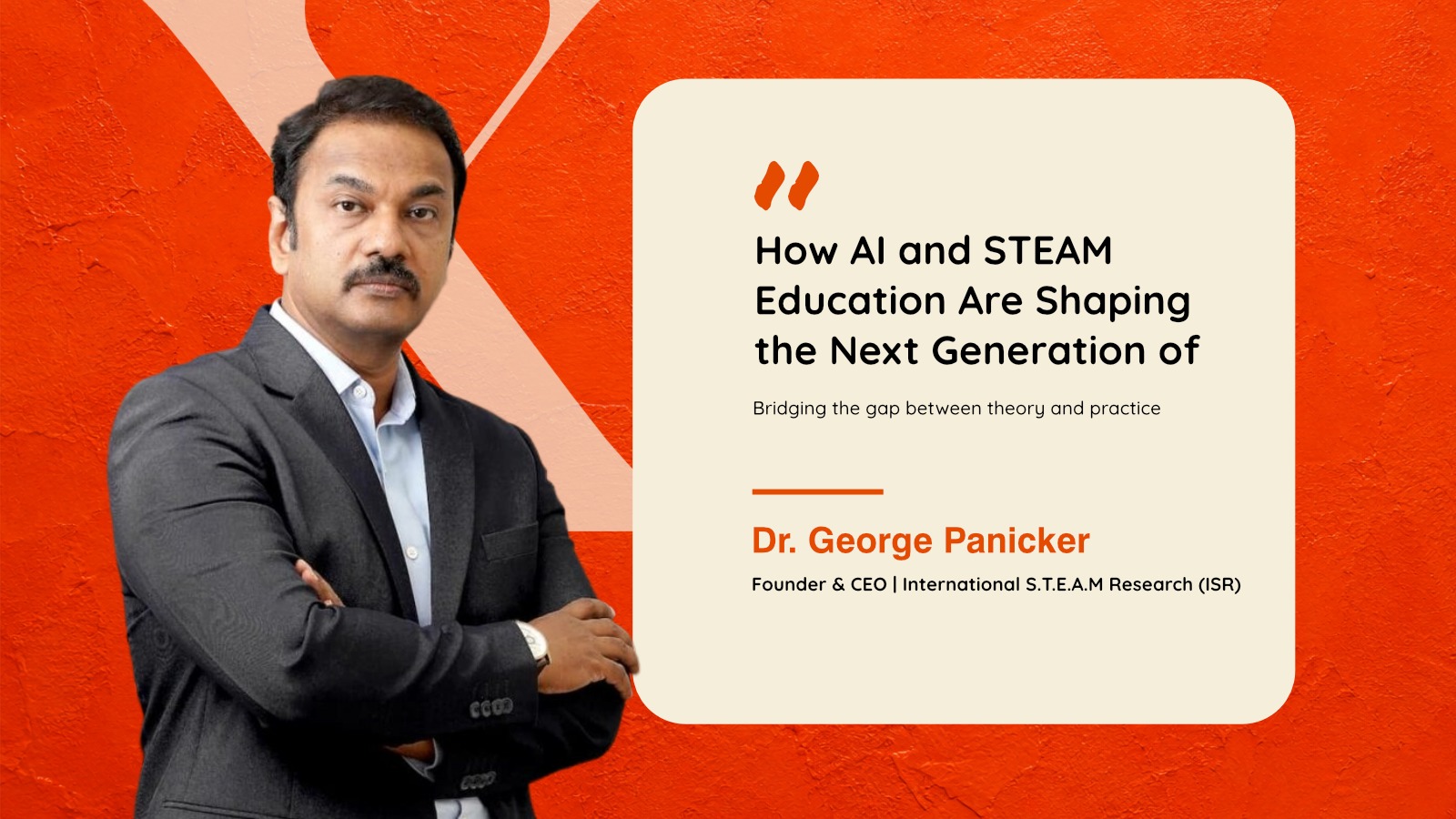
Among the education leaders contributing to this changing conversation is Dr. George Panicker, an educationist, researcher and academic leader whose work has focused on research driven education, STEAM learning and learner autonomy.
His approach places particular importance on giving learners greater ownership of their educational journey.
Rather than treating students as passive recipients of information, this model encourages them to ask questions, explore ideas, conduct research and develop solutions.
His work through International STEAM Research reflects this broader vision of connecting research, innovation and experiential learning.
EliteX recently featured this journey in its profile, George Panicker: Shaping the Future of Global S T E A M Education, exploring his work across STEAM education, research, AI powered experiential learning and global academic collaboration.
The feature also recognizes his contribution as India’s Exceptional Business Leader of the Year, 2026, reflecting the growing connection between educational leadership and innovation.
From Learning Information to Applying Knowledge
One of the biggest challenges facing education is the distance between theoretical knowledge and practical application.
Students can memorize information and still struggle to apply it when confronted with an unfamiliar problem.
Experiential learning addresses this gap by giving learners opportunities to apply knowledge through projects, research, experimentation and real world challenges.
This approach can also change how students understand failure.
A failed experiment is no longer simply a wrong answer. It can become an opportunity to investigate what happened, modify an approach and try again.
That process closely resembles how innovation happens outside educational institutions.
Researchers, engineers, entrepreneurs and technology professionals rarely solve complex problems on their first attempt. They investigate, test, learn and adapt.
Education that incorporates these principles can help prepare learners for environments where adaptability is just as important as technical knowledge.
The Human Element Cannot Be Removed
The rapid adoption of AI has created understandable questions about the future role of teachers.
Yet the strongest applications of AI in education are not necessarily those that attempt to eliminate human involvement.
Technology can provide information, identify patterns and automate repetitive activities. Teachers provide mentorship, encouragement, judgment, empathy and context.
These human capabilities remain difficult to replace.
AI can tell a learner that an answer is incorrect. A teacher can help that learner understand why the mistake happened and encourage them to try again.
That distinction matters.
The future of education is therefore more likely to involve collaboration between educators and intelligent technologies rather than a simple replacement of one with the other.
Building Globally Relevant Learners
Another important aspect of modern education is global exposure.
Students increasingly need to understand problems that cross geographical and cultural boundaries. Climate change, technological development, healthcare, sustainability and artificial intelligence are examples of issues that require international collaboration.
Research based STEAM education can give learners opportunities to engage with these challenges at an earlier stage.
Dr. George Panicker’s international academic work reflects this idea of connecting learners and educators with broader research and innovation ecosystems.
His profile in the EliteX magazine highlights his involvement in international collaborations, research initiatives and platforms that encourage students to participate in innovation challenges and academic activities.
This approach can help students develop more than subject knowledge. It can help them develop confidence, communication skills, research capabilities and a broader understanding of the world around them.
Responsible Innovation Must Remain Central
As educational institutions adopt AI and other emerging technologies, responsible innovation must remain part of the conversation.
Student privacy, cybersecurity, algorithmic bias, accessibility and ethical decision making cannot be treated as secondary concerns.
Technology should expand educational opportunity rather than create new barriers.
The same principle applies to AI generated content and automated decision making. Human oversight remains important when technology influences educational pathways, assessments or student support.
The objective should not simply be to create technologically advanced classrooms.
It should be to create better learning environments.
The Next Chapter of Education
The convergence of AI, STEAM education and experiential learning could fundamentally change how future generations prepare for work and life.
Students will need more than the ability to remember information. They will need to investigate problems, collaborate across disciplines, understand technology, communicate ideas and continuously adapt to new circumstances.
Educators will increasingly become facilitators of discovery while AI and digital tools provide additional layers of personalized support.
Leaders such as Dr. George Panicker represent one part of this wider movement toward research driven, interdisciplinary and learner centered education.
His work demonstrates how STEAM can extend beyond a collection of academic subjects and become a broader approach to developing curiosity, creativity and problem solving.
As these ideas continue to evolve, platforms such as The EliteX are also playing a role in bringing greater visibility to leaders and ideas shaping business, technology, education and innovation.
The future of education will not be defined by technology alone.
It will be defined by how intelligently technology is combined with human curiosity, creativity, research and purpose.
That is where the real potential of AI powered STEAM education begins.